PROJECT OVERVIEW
Augmented Reality
Augmented Reality helps Etsy mobile buyers preview wall art in their homes, helping them buy with more confidence.
-
Etsy is a global e-commerce marketplace focused on handmade or vintage items and craft supplies. Its marketplace includes categories such as jewelry, apparel, home decor, furniture, toys, and art. The company was founded in 2005, and is headquartered in New York City.
Etsy - iOS App
PROBLEM DEFINITION
How to Improve Buying Art
Etsy's Art & Collectibles category has more than five million items, from vintage oil paintings, photography to prints. Finding a piece you love is only half the challenge, the harder part is imagining it on your wall.
Will it fit the open corner of a gallery wall? Is 8"×10" too small above the sofa? Will the colors work with the room? Listing photos couldn't answer these questions. Sellers often photograph art in styled rooms to show scale, but those rooms aren’t the buyer’s own, and the dimensions in a listing are hard to translate into a real space.
This uncertainty made buyers hesitate at the moment of purchase. They saved items instead of buying, messaged sellers about sizing, or bought and hoped for the best, risking disappointment with a one-of-a-kind item that often resulted in returns.
Key Problems
Style fit is uncertain: Seller photos showed art in someone else’s room, not the buyer’s, making it hard to tell whether it would suit their style.
Inconsistent listing images: Some sellers upload standalone artwork, while others show it framed on a wall, which made it hard for buyers to judge the piece itself.
Tape measure is inefficient: Buyers struggled to translate listed dimensions into how a piece would look on their wall, so they relied on a tape measure.
Hesitation at checkout: Uncertainty led to saved-but-not-bought items and, at times, extra questions to sellers.
Frequent returns: Buyers often misjudged how art would look in their space and sent it back, making Art & Collectibles one of the platform’s most frequently returned categories.
PROJECT GOALS
Business Goals
In 2020, Etsy reported that searches for wall decor and art were up 94% compared to the same period a year earlier, with paintings up 63% and prints up 54%. This demand created an opportunity to turn interest into sales by helping buyers choose art more easily. Etsy defined these specific business goals:
Increase conversion on wall art listings by helping buyers feel confident, which drives sales for the independent sellers and artisans who make up Etsy’s marketplace.
Reduce returns caused by pieces that didn’t fit the buyer’s space or style.
Differentiate Etsy from competitors, since most don’t support AR for wall art.
Feature Goals
The team and I aligned on measurable feature goals that support the overall business strategy.
Drive adoption where buyers launch the AR experience.
Drive completion rates where buyers successfully placed the art on their wall.
Drive add-to-cart rate where AR sessions end with the item added to the cart.
DESIGN PROCESS
Design Process
I led the end-to-end user research and design process, partnering with iOS engineers, the product manager and other stakeholders to deliver this new feature with the goal to improve buying art.
User Research
User interviews
Personas
Competitive analysis
Usability testing
Affinity map
Design
User flows
Wireframes
High-fidelity design/prototype
Final design
Design handoff
USER RESEARCH
User Interviews
I interviewed 8 Etsy buyers who had recently bought or browsed wall art to understand how people choose art for their homes and what stops them from buying.
Buyers described buying art as a personal, emotional decision, and sometimes a risky one. Many measured their walls with a tape measure, held up paper cut-outs, or compared listing photos against their furniture to guess the scale. Even then, they often weren’t sure until the piece arrived. With handmade and custom items, returns, when possible, felt like a hassle, so buyers wanted to be certain before buying.
Key Findings
Scale is the biggest unknown: Buyers could judge style from photos, but not whether a piece would look too small or overwhelming on their wall.
Style fit is hard to judge: Styled room photos helped, but buyers wanted to see the piece in their own space to feel confident it matched their style.
Returns are a last resort: Buyers saw them as a hassle, and some items can’t be returned at all, which raised the risk of buying even further.
AR is familiar to some: 2 of 8 participants had already used AR to shop for furniture and were curious to try it for art on Etsy.
Persona
I synthesized the interview findings into a persona representing a targeted Etsy buyer.
Competitive Analysis
Competitive analysis revealed where competitors are strong, where they fall short, and where Etsy could differentiate. Most don’t offer AR for wall art, which made it a clear opportunity.
DESIGN
User Flow
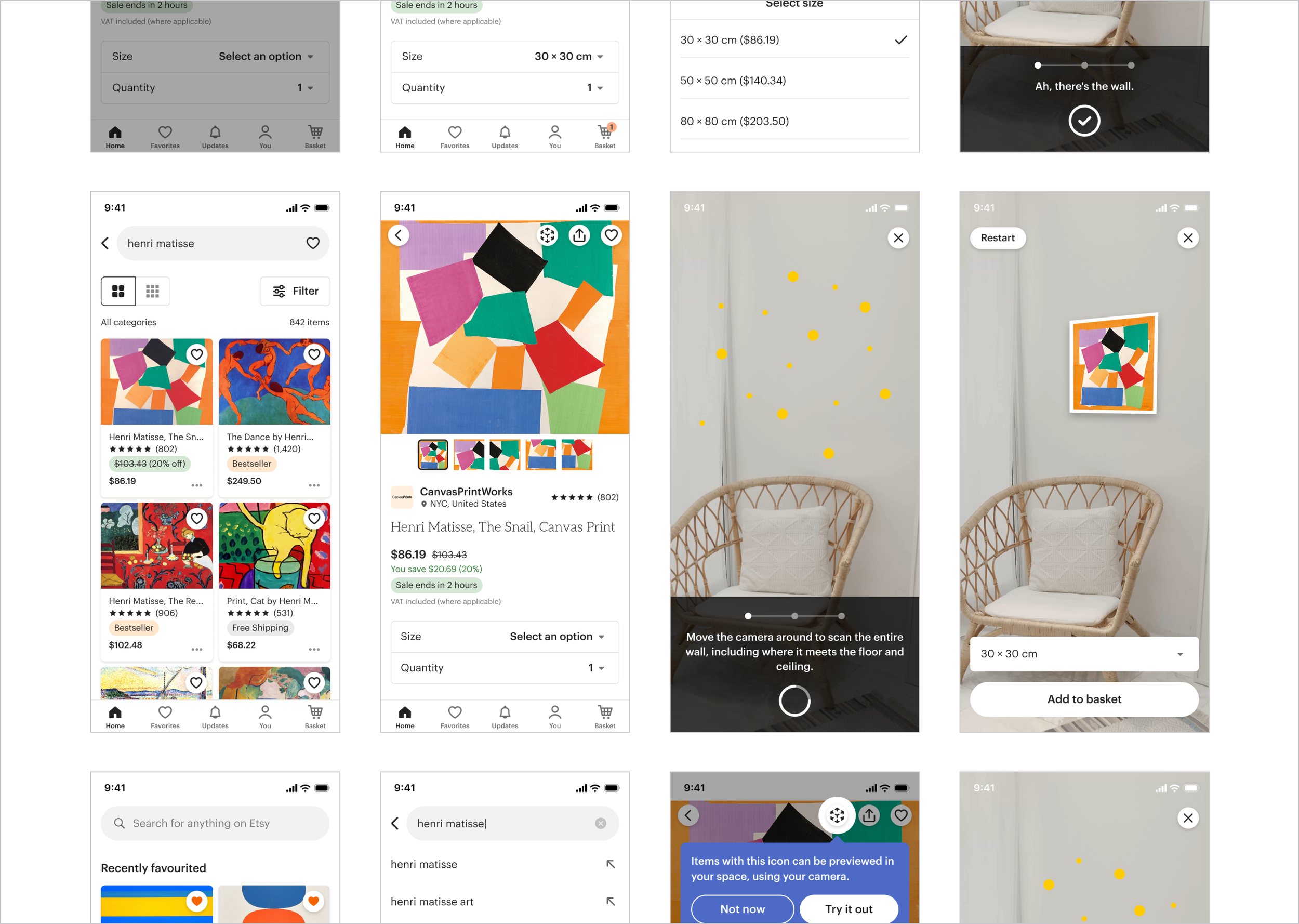
AR introduces steps buyers have never done in the Etsy app: scanning a room, finding a wall, and placing a virtual object. This flow shows how I turned a complex process into an intuitive, guided experience, from the listing page to art on the wall to checkout.
Wireframes
After defining the user flow and aligning with the team, I started wireframing to quickly explore solutions. The end-to-end process was already clear, but I wasn’t sure how best to guide buyers through it.
In my first exploration (pictured below), each step used an illustration and a short instruction: point the camera at the wall and ceiling, then tap to place the item.
In the final version (also pictured below), I replaced the illustrations with a three-step tracker and clear instructions (“Move the camera around the room,” “Place the item on the wall”), so buyers always know where they are in the process.
I also wasn’t sure whether to preselect a size in Step 3 if the buyers hadn’t chosen one on the listing. After aligning with the team, we decided to preselect a size based on the wall’s dimensions, then let buyers compare other sizes on their own wall before adding to cart.
USER RESEARCH
Usability Testing
After building a high-fidelity prototype, I ran a moderated usability testing with 5 Etsy buyers to evaluate the discoverability and ease of use of the new AR feature. Participants completed three tasks:
Find a Henri Matisse painting and open the first listing
Preview the art on their wall
Change the item size
All 5 participants completed every task without errors, and the satisfaction score was 4.4 out of 5. This suggests that participants found the AR feature easy to discover and simple to use.
Affinity Map
I grouped the feedback into an affinity map to find patterns beyond the task results.
Positive feedback: 5 of 5 participants found the feature easy to discover and use, and 3 of 5 said it made them more confident about buying.
Negative feedback: 2 of 5 didn’t notice AR support in search results, and 2 of 5 weren’t sure how to restart the wall scan.
Neutral feedback: 1 of 5 raised edge cases, such as items that already have a frame, tilted listing photos, or a person blocking the wall.
Feature requests: 2 of 5 wanted AR for other categories, and 1 of 5 asked for a way to share the preview.
Next steps: Decide whether to show AR in search results, let buyers restart the scan, define when to show a frame, and how to handle tilted angles.
SOLUTION
Buying Art, Improved with AR
The AI-powered AR feature lets buyers preview art on their own wall before purchasing. It’s available for iOS users on listings in Paintings, Photography, and Prints, within the Art & Collectibles category. It helps buyers make more confident purchases while supporting the small businesses and artisans who sell on Etsy.
Key Improvements
Clearer style fit: Buyers see art on their own wall, not in someone else’s room.
Consistent images: Image extraction and frame detection give the AR view a clean image of the art, whatever the seller uploaded.
No more tape measure: Art appears at actual size, with sizes to compare in the preview.
Less hesitation: A guided three-step flow leads to a size-preselected preview with Add to cart right in the AR view, so buyers can decide on the spot. This reduces saved-but-not-bought items and back-and-forth with sellers.
Fewer returns: After previewing the art, buyers feel more confident about keeping it.
-
The AR experience was built leveraging Apple’s frameworks and on-device AI (machine learning):
Vision extracts the artwork from the listing photo so it can be placed in 3D.
Core Image crops the image when needed.
Image classification detects whether a listing photo includes a frame, so the app knows whether it needs cropping.
ARKit and SceneKit place the artwork in the buyer’s space.
DESIGN
Final Design
Following validation with users and aligning with the team, I designed the end-to-end AR experience for Etsy buyers.
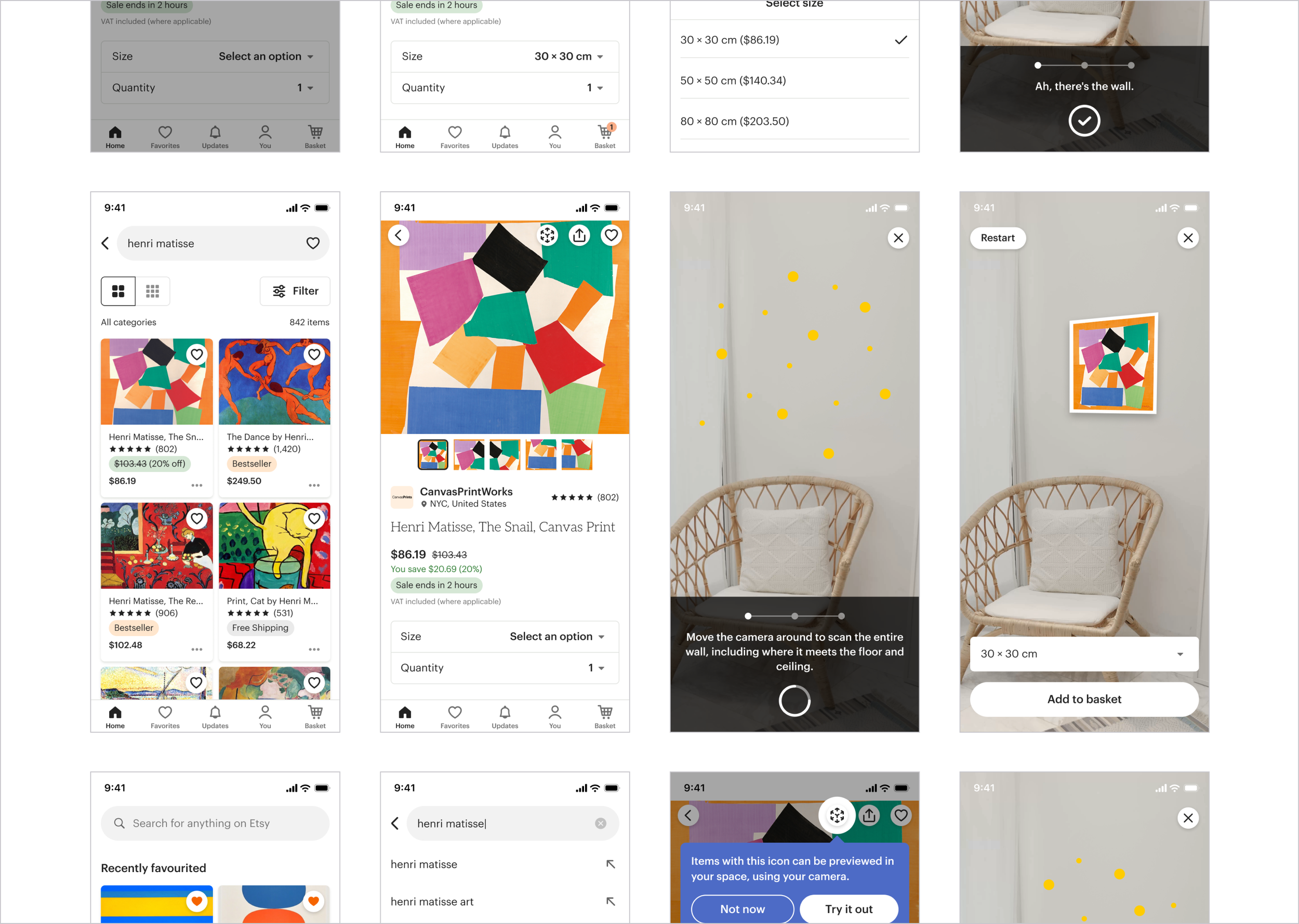
Because most buyers don’t think to look for AR, a tooltip on supported listings points to the AR icon and explains that they can preview art in their space. Once AR opens, a three-step tracker guides them as they scan the room, find a wall, and place the art.
Usability testing showed that 2 of 5 participants weren’t sure how to restart the scan, so I added a Restart option to give buyers more control.
To preview the AR experience, you can view the prototype.
Note: the prototype has limited functionality.
Design Principles
Keep commerce buyer-friendly: Make finding unique art feel gratifying, and connect buyers with the sellers who made it.
Keep buyers informed: When buyers know what’s happening, they see the result of their last action and know what to do next. Predictable interactions build trust in the product and the brand.
Keep buyers in control: Buyers should be able to leave or restart any unwanted action quickly, so they feel supported, not stuck.
Challenges and Trade-Offs
Discoverability
Buyers can’t tell whether a listing supports AR until they open it. Search cards already have a heart over the image and a More icon at the bottom right. Since AR relates to the image, the natural spot for an AR icon is next to the heart, but it would partly cover the artwork and behave differently from the heart’s quick save. I chose to omit it and keep the cards clean, though 2 of 5 usability testing participants didn’t notice AR in search.
Calibration
Calibration, the wall scan that lets the app detect a wall and place the art on it, is the first hurdle in any AR experience. It’s new to most buyers, who have little past experience to draw on, so they need clear instructions to know what to do.
Buyers who had used AR before, for example to shop for furniture, need less guidance. For them, too much explanation creates friction and can lead to drop-off. A three-step tracker with brief text gave both groups the guidance they needed without information overload.
Platform Limitation
Etsy’s AR feature is only available for iOS users as it relies on Apple’s technology. ARKit places the artwork on the wall through the camera, while the Vision framework and Core Image identify and process the artwork images.
Android uses a different platform, Google ARCore, so supporting it would mean adapting or rebuilding parts of the experience for a different technology stack and a wider variety of devices. Thus, the Android support was descoped.
The images below show the iOS app experience.
Etsy - iOS App
IMPACT
KPIs
The AR feature delivered positive business outcomes, increasing purchase conversion and reducing return rates. It also achieved strong adoption and engagement, with high completion and add-to-cart rates.
15M+
iOS monthly active users
+12%
conversion rate increase
-10%
return rate reduction
40%
adoption rate
15%
add-to-cart rate
84%
completion rate
How We Measured Success
Conversion rate (+12%): Increase in purchase conversion among buyers who used AR compared with those who didn’t, measured across wall art listings.
Return rate (-10%): Reduction in wall art order returns, particularly those related to size or style mismatches.
Adoption rate (40%): Percentage of eligible wall art listing views that resulted in buyers launching the AR experience.
Completion rate (84%): Percentage of AR sessions in which buyers successfully placed the art on their wall.
Add-to-cart rate (15%): Percentage of AR sessions that resulted in an add-to-cart event.
AR engagement metrics were tracked through Firebase, while order and return data were sourced from Etsy’s transaction records.
Customer Feedback
“The AR feature helps me see how artwork will look in my home before I buy it. I feel more certain in my choices and can find the right piece for my space without the guesswork.”
Etsy Buyer
PROJECT DETAILS
Project Details
Role: Product Designer / UX Researcher
Company: Etsy
Industry: E-commerce
Market: B2C marketplace
Team: Product Designer / UX Researcher (me), Design Leadership, Product Manager, Engineering
Framework: Agile
Tools:
Design: Figma, Miro
User research: Maze
Project management: Jira, Confluence
Product analytics: Firebase
Year: 2020
Platform: Mobile
App: iOS